
EU Defence - "Effectively Useless" or Surprisingly Capable?
The Audit of the Alliance
A business is only as strong as its contracts. For decades, the American taxpayer has felt like the majority partner in a firm where the minority shareholders were not paying their dues. Donald Trump was not wrong to point this out. He demanded that allies pay for the security infrastructure the US provided. But he is oversimplifying the situation.
In a recent interview with The New York Times, Trump stated that the NATO alliance is "effectively useless" without American leadership and hardware. He argued that European nations provide no real deterrent on their own, claiming that Russia "fears only the U.S." and that if he weren't in power.
There is no denying that the US military is the most powerful force in human history. It is designed to project power across oceans. It is built to win quickly and decisively. It's also true that for a long time, Europeans took this for granted. They underspent. They let their stocks dwindle. After the cold war ended, they treated peace as a natural state in Europe rather than a managed outcome.
But everything changed when Russia invaded Ukraine. The "peace dividend" ended. Today, the 2026 data shows a different reality. Poland is spending nearly 5 percent of its GDP on defense. Germany has overhauled its constitution to fund a massive military expansion. The era of the European under spending is over.
This had little to do with the words of Trump, and everything to do with the actions of Putin.
Two Philosophies of Power
Spending is a metric, but it is not a capability. If you spend a billion dollars on a golden hammer, you still only have one hammer. The US and its allies have different philosophies of war. These differences are not flaws and one of them are not necessarily better than the other. They are a product of culture, geography and the natures of the threats.
But they are hard to compare solely based on spending.
The US military is built for the "Preemptive Strike." It assumes air superiority. It relies on high-tech, expensive equipment that requires a massive logistics tail. It is a scalpel designed for global reach.
The Europeans build for "Territorial Defense." Their focus is on long-term attrition. They assume the fight will be on their own soil. They prioritize simple, reliable, and field-serviceable equipment. They need to be able to ramp up production in local facilities during a crisis.
The Sky: F-35 vs JAS-39 Gripen E
The US F-35 is a marvel of stealth and sensor fusion. It is designed to penetrate the most advanced air defenses on day one of a war. It is also expensive to fly. It requires pristine runways and specialized maintenance crews.
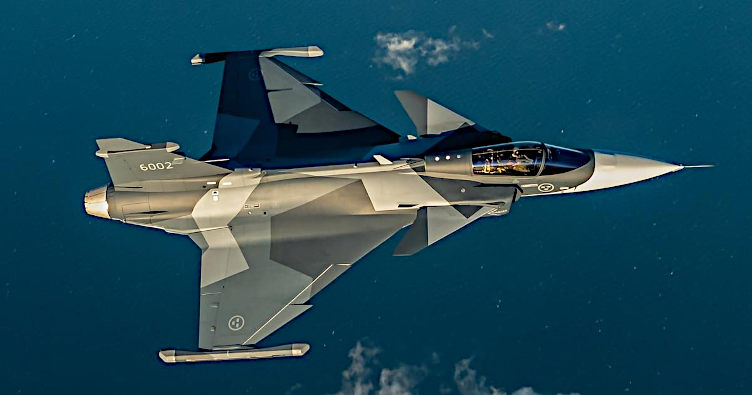
The Swedish Gripen E takes a different path. It is designed to operate from dispersed road bases. It can be refueled and rearmed in ten minutes by a small crew of conscripts. It is built for a war where the main airbases have already been destroyed.
The Gripen E now integrates with the GlobalEye surveillance aircraft. Together, they create a networked swarm of drones and sensors. This system is designed to fight in a contested environment where stealth alone is not enough. It is a blue-collar solution to a high-tech problem.
The maintainability doesn't just mean lower cost. It also means that each plane spends less time in maintenance, meaning fewer planes are needed to uphold the same number of planes that are ready to operate.
The Ground: Abrams vs Leopard 2
The M1 Abrams is a beast of a tank. It uses a gas turbine engine, much like a jet. It is fast and powerful. It also requires a separate, complex fuel logistics chain. It drinks fuel at a rate that would bankrupt a small nation.
The German Leopard 2 uses a standardized diesel engine. It is more reliable in the long term. It is easier to maintain in the field. Most importantly, it can share fuel with every other truck and vehicle in a European convoy. In a war of attrition, the ability to simplify your supply chain is more valuable than raw horsepower.
The Sea: Super Carriers vs Diesel-powered Submarines.
The ocean is the ultimate test of value for money. In 2005, the $6.2 billion USS Ronald Reagan faced a small Swedish diesel submarine in a series of war games. The HSwMS Gotland cost roughly $100 million. On a balance sheet, the carrier should have won by default.
The reality was a shock to the system. In multiple exercises, the Gotland penetrated the carrier strike group defenses. It evaded destroyers, helicopters and sensors undetexted and scored "virtual kills" on the Reagan and then vanished.
Greenland and the Arctic Reality
Trump recently claimed that the only way to defend the arctic is through "Total US Control" of Greenland, ignoring facts such as that the tiny Nordic countries together have more than five times as many ice breakers as the USA. Finland alone has three times as many.
Canada, Greenland's nearest neighbor, has six times as many as the US.
And equipment is only half the story. Geography dictates capability. In recent arctic exercises like Joint Viking and Freezing Winds, we saw this in practice. US Marines are elite fighters. However, they found themselves struggling against Finnish forces in sub-zero conditions.
The Finns have spent a century learning how to live and fight in the deep cold. In some simulations, US troops were forced into "simulated surrender" because their equipment or their bodies could not handle the extreme environment. This is not a slight against the Marines. It is proof that NATO needs local expertise. You cannot buy a century of survival knowledge with a defense contract.
The Bottom Line
NATO is a diversified portfolio of security assets. The US provides the heavy lift and the global reach. Europe provides the local grit, the specialized technology, and the industrial depth. If NATO were to fall, Europe has the technology and the economic weight to stand alone.
But let's be honest. All NATO countries benefit from the collaboration and, ultimately, the strength of Article 5. And this includes the only country ever to have invoked it — we, the US.