
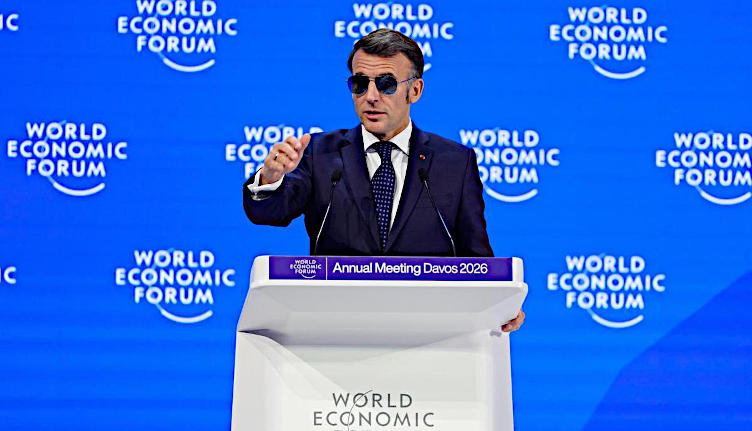
Macron and Carney speak at Davos
The Delayed Arrival
Donald Trump is currently traveling to Davos for the World Economic Forum. His trip began with a technical failure on Air Force One. An electrical issue forced the aircraft to return to Joint Base Andrews shortly after takeoff. The president eventually departed on a smaller C-32 aircraft. He arrives late to a forum where the atmosphere has already hardened against him.
The Davos Rupture: Law vs. Force
Emmanuel Macron and Mark Carney delivered the opening salvos of the week. Macron spoke of a world sliding toward the law of the strongest. He warned against a "new imperialism" where trade is used as a weapon for territorial gain.
Europe as a Safe Harbor
Macron positioned Europe as the world harbor for stability and predictability. His speech was an invitation for capital to flee volatility for the safety of the European market. He made it clear that markets crave the rule of law, stability, and predictability for investments.
The Trade Bazooka
Macron threatened to use the European Union trade bazooka if the US continues to weaponize tariffs. Not to disrupt stability, although that might be a short-term consequence, but to preserve it in the long run.
The End of the "Pleasant Fiction"
Mark Carney was even more blunt. The Canadian Prime Minister declared that the rules-based order is dead. He called the concept a pleasant fiction that nations can no longer afford to maintain. Carney referenced the concept of living within the lie. He argued that middle powers must stop pretending the old bargain still exists. He told the audience that those not at the table are on the menu.
Analysis: Institutional Realism
These speeches mark a shift to institutional realism. A nation that uses tariffs as a ransom for territory is not a partner. A nation that rolls out the red carpet for a dictator and puts pressure on it's allies is an adversary. It is a systemic risk and Europe is divesting politically, militarily and financially. The American Brand was once built on the certainty of the law. Or at least the pretense of it. Now, Europe and Canada are signaling that they will prioritize their own sovereign equity and stable alliances over unreliable actors turned adversaries.
The Boardroom Misconception
Trump responded to these criticisms during a press briefing before his departure. He claimed that he gets along well with Macron and Keir Starmer. He suggested they treat him well in person but act tough when he is away. He viewed the international friction through the lens of personal rapport. He even released private text messages from Macron to prove they were on good terms.
Manners vs. Submission
This reaction shows that Trump doesn't understand the diplomatic game even on a basic level. Trump mistakes professional decorum for personal submission. He doesn't understand that politeness is a requirement of the office and a tool for negotiation. It is not a sign of friendship or agreement. European leaders are not performing for a US audience. They are CEOs protecting their national interests. Mistaking a polite client for a loyal partner is a fatal flaw in strategic management.
The New Red Lines
A new era of direct communication has begun. The era of vague diplomatic and polite statements is over. Middle powers are now establishing clear red lines. They are speaking the language of power and economic defense. Expect Europe to use its trade defenses if the Greenland threats continue. The fiction of the old alliance is gone and the US is no longer treated as a flaky and unreliable friend, but an adversary.
Bottom line: When the lead partner stops following the rules, the rest of the board moves to protect the firm.